
REVIEW · OLD CITY WALKS
Guided Old City Tour on Baku’s Timeless Charm
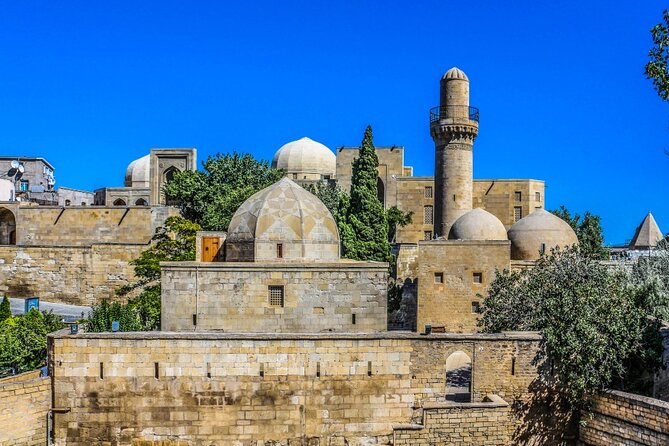
Baku’s past is packed into a walkable maze. This roughly two-hour tour introduces you to Icherisheher, Baku’s walled Old City, through its gates, caravanserais, mosques, baths, towers, and palace courtyards. I especially like the small maximum group of 15, which should make it easier to hear the guide and ask questions. The route also includes several free historic sites that many short city walks skip.
The strongest parts are the Maiden Tower and Shirvanshah’s Palace, the two major monuments at the center of Baku’s UNESCO designation. At $25 per person, the price is fair for a guided introduction, though admission to both headline monuments is not included. If you want a slow visit inside each site, this tour may feel brisk.
- Gosha Gala Square begins the walk at Baku’s historic Double Gates, a useful place to get your bearings.
- Two medieval caravanserais reveal how merchants and long-distance trade shaped the Old City.
- The Maiden Tower and Shirvanshah’s Palace provide the tour’s main architectural highlights, with entrance fees paid separately.
- Bathhouses, mosques, and an old bazaar complex show how ordinary city life once worked.
- The Museum of Miniature Books and Ali Shamsi’s workshop add unusual modern touches to the old streets.
- Free cancellation up to 24 hours ahead gives you some flexibility if your Baku plans change.
In This Review
- Why Baku’s Old City Works Best on Foot
- Gosha Gala Square and the Double Gates
- Caravanserais and the Medieval Trade Route
- The Maiden Tower, Baku’s Most Recognizable Landmark
- The Old Bazaar, St. Bartholomew, and a Buried Bathhouse
- Caravanserais, Mosques, and the Old City’s Working Life
- Three Historic Baths and a Poet’s Monument
- Miniature Books and Ali Shamsi’s Unusual Studio
- The Shirvanshah Palace and the Final Fortress Tower
- What $25 Really Gets You
- Who Should Book This Baku Walk?
- Should You Book the Old City Tour?
- FAQ
- How much does the Baku Old City Tour cost?
- How long does the tour last?
- Where does the tour begin?
- Where does the tour end?
- Is the Maiden Tower admission included?
- Is admission to Shirvanshah’s Palace included?
- What is the maximum group size?
- Can I cancel for a full refund?
Why Baku’s Old City Works Best on Foot
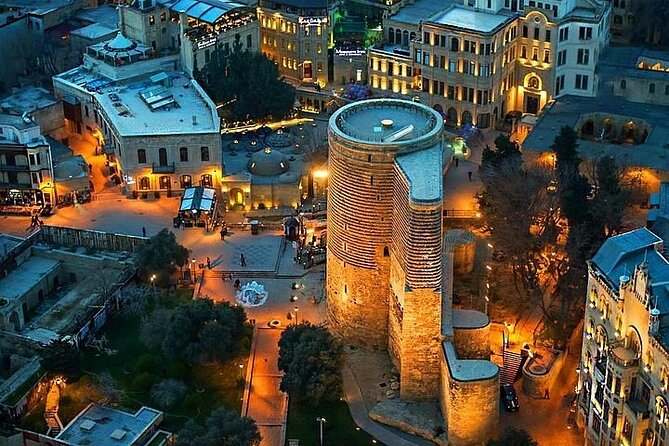
Icherisheher is not a single monument. It is a compact historic district enclosed by fortress walls, where narrow streets connect religious buildings, trade stops, private homes, courtyards, and royal remains. A guide helps turn these scattered pieces into a story.
The Old City also rewards walking because the details are close together. You move from a medieval gate to a caravanserai, then to a tower or bathhouse within minutes. The route is mostly about seeing and understanding rather than covering a large distance.
The tour is listed at approximately two hours, and the schedule is tightly arranged. The planned stops add up to about 90 minutes before walking time, so the pace is likely steady. You should be ready to keep moving, especially if the guide gives full explanations at the Maiden Tower and palace.
The starting point is Gosha Gala Square at 47 Kichik Qala. The walk returns to the same meeting point, which is handy if you plan to continue exploring Baku afterward or need to find your way back to public transportation.
Gosha Gala Square and the Double Gates
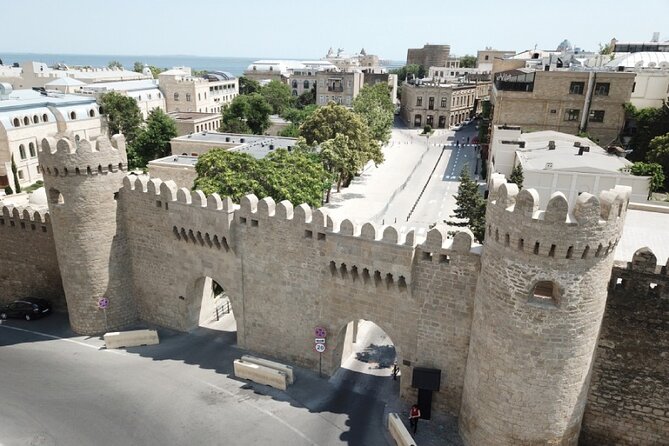
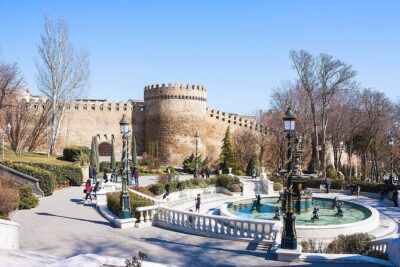
The Double Gates, called Gosha Gala in Azerbaijani, are the natural opening scene. These fortress gates date to the 12th century and formed part of Baku’s defensive system.
The two-minute stop is short, but the location matters. It gives you an immediate sense of the Old City as a fortified settlement rather than simply a pretty historic quarter. Look at the scale and position of the gates before following the guide inside.
There is no admission charge here. Since the tour begins in a central part of Icherisheher and public transportation is nearby, this is a practical meeting point for a first visit to Baku.
More walks around the Old City:
- Baku Oil Heritage & Old Town Walking Tour
★ 5.0 · 232 reviews - Guba Khinalug & Candy Cane Mountains tour (by Old City Tours)
★ 4.5 · 208 reviews - Gabala + Shamakhi tour (by Old City Tours)
★ 4.5 · 198 reviews
Caravanserais and the Medieval Trade Route
The Bukhara Caravanserai and Multani Caravanserai are among the most useful stops for understanding the commercial side of the Old City.
The Bukhara Caravanserai was built at the end of the 15th century along the Old City’s commercial route. Its central courtyard, raised entrance, surrounding balconies, and private rooms were designed for merchants and their animals. The courtyard was more than an architectural feature. It was a shared place where traders gathered after a day of business.
The Multani Caravanserai dates from the 14th century and sits opposite the Bukhara building. It housed merchants from Multan, a historic city in present-day Punjab, Pakistan. The stop also opens a window onto the religious variety connected with trade. Zoroastrian merchants are associated with the building, and they are also linked with the Ateshgah Temple at Surakhani.
Each caravanserai receives about two minutes, so you will not have time for a long architectural study. Still, these stops are valuable because they explain why Baku grew where it did. The city was tied to routes moving goods, people, and ideas across the Caspian region.
The Maiden Tower, Baku’s Most Recognizable Landmark
The Maiden Tower receives the longest early stop, about ten minutes, though its admission fee is not included. It is a 12th-century monument and one of Azerbaijan’s best-known national symbols.
The tower’s purpose and earlier history have prompted different interpretations. Some scholars connect it with pre-Islamic and Zoroastrian traditions, while others focus on its role within Baku’s medieval defenses. A good guide can explain these competing views without pretending that every mystery has one certain answer.
If you want to go inside, budget separately for the ticket. The tour price covers the guide, not all entrance fees and taxes. The schedule allows time to see the tower from outside, hear its story, and possibly enter, but it does not promise an extended visit.
This is one place where the tour’s timing matters. If the Maiden Tower is a personal priority, ask the guide how much time is available for admission before buying a ticket. You may prefer to return later for a slower visit.
The Old Bazaar, St. Bartholomew, and a Buried Bathhouse
The next part of the walk shifts from famous monuments to smaller sites with strong local context.
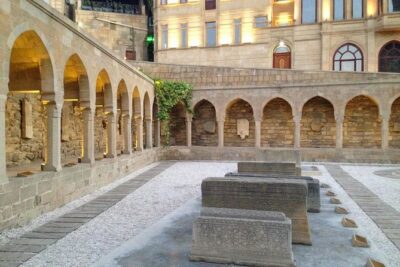
The Bazar Square, also known as the Khanqah complex, dates from the 12th or 13th centuries. Its arcades form part of a historic religious and architectural complex near the Maiden Tower. Archaeologists uncovered it during excavations in 1964. The three-minute stop is brief, but it helps you picture the Old City as a place of worship, trade, and public gathering.
St. Bartholomew Church offers a different layer of Baku’s story. Built in 1892 with donations from the local Christian community, it stood on a site associated with the apostle Bartholomew. The church operated until 1936, when it was demolished during an anti-religious campaign. The original building is gone, so this stop is about memory and changing religious life rather than a grand interior.
The Haji Ghayib, or Haji Bani, Bath is more physically present. Built at the end of the 15th century, it was found underground during archaeological work in 1964. Its location along a caravan route reflects the important role of public baths in Muslim cities.
You receive about five minutes here. That is enough to notice the domed rooms and the way the building once handled bathing, heating, and movement from one chamber to another. It is a small but telling stop, showing how urban life worked beyond palaces and monuments.
A completely different kind of day out:
- Baku: Gobustan, Mud Volcano, Fire Mount, Temple Lunch Entry
★ 4.9 · 3,246 reviews - Baku: Guba, Shahdag, Laza & Lunch w/ Free City & Night Tour
★ 4.8 · 1,455 reviews - BEST Gobustan, Volcanoes & Absheron Fire Tour (Group or Private)
★ 5.0 · 1,254 reviews - Gobustan and Absheron tour (All inclusive)
★ 5.0 · 1,014 reviews
Caravanserais, Mosques, and the Old City’s Working Life
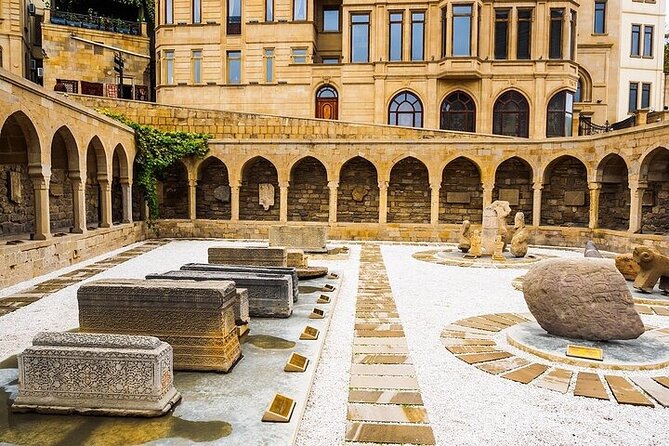
The Two-Storey Caravanserai, also called the Gasim Bey Caravanserai, dates from the 15th century. It is linked with the period of Shirvanshah I Khalilullah and later with Gasim Bey and his heirs after Baku became part of the Russian Empire.
The name and later use show how buildings changed owners and purposes as political control shifted. You will spend about three minutes here, enough for a concise explanation and a look at the courtyard form.
The Juma Mosque brings the religious story forward. An inscription records restoration in 1309, and a minaret was added in 1437. The current mosque was built in 1899 with funding from Haji Shikhlali Dadashov, a Baku merchant and philanthropist.
The site also has connections to an earlier Zoroastrian temple. That mixture of layers is typical of Baku, where older religious traditions, Islamic architecture, and later rebuilding often occupy the same small area. The five-minute stop should give you a useful introduction, but it is not designed as an extended mosque visit.
The Small Caravanserai, built in the 12th century, has a square plan and inner courtyard with cut corners. Its north and south entrances are shaped like portals, and the building once had a defensive role. During the medieval period, the main entrance was connected with the sea, a reminder that Baku’s waterfront was once much closer to daily trade routes than it may appear today.
Three Historic Baths and a Poet’s Monument
Baku’s bathhouses give the route an unusually human scale. They tell you about washing, social habits, heating, water supply, and the practical needs of city residents.
The Gasim Bey Bath dates from the 17th century and was also called the Sweet Bath because bathers were served sweets with tea. Its traditional plan included an entrance, changing room, bathing areas, pools, and a boiler room. Ceramic pipes in the walls and floors carried water and heat.
The building was reconstructed in 1970 and later became a pharmacy called the Green Pharmacy. This is a good example of how historic structures are not always preserved as frozen museum pieces. Their uses can change while the architectural shell remains.
The Agha Mikayil Bath was built in the 18th century by Haji Agha Mikayil from Shamakhi. It differs from other baths on the route because of its large interior and square changing and bathing rooms. Pointed arches, domes, and a chimney shape the building.
The bath was restored in 2010 and remains a functioning bath. The tour does not promise entry or bathing, so think of this as an exterior and architectural stop. Both bathhouses receive only a few minutes.
The Aliagha Vahid Monument adds a more recent cultural note. Vahid was an Azerbaijani poet and ghazal singer who lived from 1895 to 1965. The monument was completed in 1990 by sculptor Rahib Hasanov and architect Sanan Salamzade.
It is a useful reminder that the Old City is not only about medieval rulers. Modern Azerbaijan also claims this historic center as a place for national poetry, art, and public memory.
Miniature Books and Ali Shamsi’s Unusual Studio
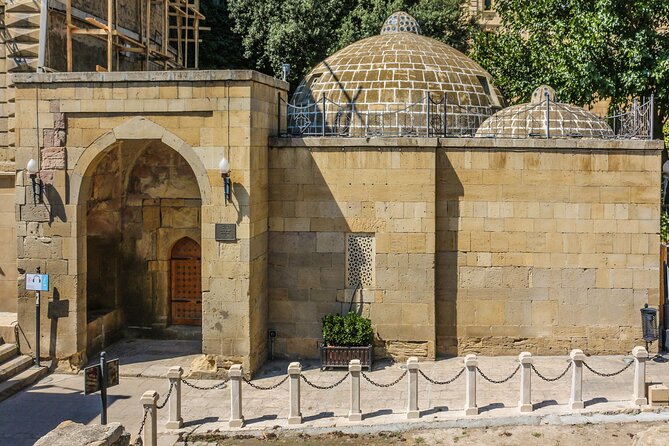
The Baku Museum of Miniature Books is one of the route’s most unexpected stops. It opened in 2002 and holds more than 6,500 miniature books from 64 countries. The collection was assembled over 30 years by Zarifa Salahova.
The museum received a Guinness Book of Records certificate in 2015 as the largest private museum of miniature books. You have about ten minutes here, making it one of the longer stops outside the two major monuments.
Because the collection includes books from many countries, it adds a wider cultural angle to an otherwise local walk. The stated aim of promoting childhood literacy also gives the museum a clear purpose beyond novelty. Admission is listed as free.
The Workshop Ali Shamsi provides another change of pace. It functions as an art studio and exhibition space for Azerbaijani artist Ali Shamsi. He studied at the Azerbaijan State Institute of Arts and later spent time near Kharkiv painting icons in a monastery.
The workshop is in the historic center, and the ten-minute visit lets you see an active creative space rather than only old stones. The information provided does not promise a formal demonstration or a purchase opportunity, so treat it as a brief cultural stop.
The Shirvanshah Palace and the Final Fortress Tower
The Palace of the Shirvanshahs is the tour’s major architectural centerpiece. Built in the 15th century, it was commissioned after the Shirvanshah dynasty moved its capital from Shemakha to Baku following a destructive earthquake.
The palace complex is recognized by UNESCO as one of Azerbaijan’s finest examples of architecture. Together with the Maiden Tower, it forms the core of Baku’s historic monument designation.
You receive about 20 minutes here, the longest stop on the route. Admission is not included, so you need to decide if you want to pay for entry. Twenty minutes is enough for an overview, but the complex deserves more time if you want to examine its courtyards and details carefully.
Across from the palace’s Murad Gate is the Beyler Mosque, a nationally important historic and architectural monument. It receives about two minutes, so the guide will likely provide a quick orientation rather than a full visit.
The final stop is the Quadrangular Tower, also known as a donjon or armory. Baku’s walls once had two major defensive lines, and repeated attacks led to several rounds of rebuilding. After restoration in the 1950s, 25 semicircular towers and one quadrangular tower remained.
Ending near the fortifications brings the walk back to its starting theme: Baku as a defended medieval city. Since the tour returns to Gosha Gala Square, you can easily continue through the Old City, return to your hotel, or seek out the sites you wanted to see at a slower pace.
What $25 Really Gets You
At $25, this is a reasonably priced introduction to Icherisheher. You are paying for a professional guide, a planned route, and historical context across a large number of sites. The value is strongest if you are new to Baku and want a clear orientation before exploring alone.
The price does not include all fees and taxes. The Maiden Tower and Shirvanshah’s Palace specifically list admission as extra, while the other stated stops are free. Add those costs if you want to enter both headline monuments.
The route includes many stops, but most are short. I would choose this tour for breadth, context, and efficient sightseeing. I would not choose it as the only Old City visit if you want long museum visits, quiet photography, or detailed architectural study.
The small-group limit of 15 is another point in its favor. It is not a private tour, but the group should remain manageable in narrow lanes and historic courtyards. Confirmation is provided at booking, and mobile tickets make the arrangement simple.
The tour operates daily from 10:00 a.m. to 6:00 p.m. The exact start time should be confirmed when booking. Free cancellation is available until 24 hours before the start time. Cancellations inside that window are not refunded, and the operator may offer a new date or a full refund if the minimum group size is not reached.
Who Should Book This Baku Walk?
I would recommend it to first-time visitors, families, and anyone with limited time in Baku. The route combines the city’s main historic symbols with less obvious sites such as buried baths, caravanserais, and the miniature book museum.
It also suits people who prefer stories to silent sightseeing. The tour description emphasizes local guides, historical explanation, personal anecdotes, and a warm group setting. The customer comments praise careful timing, organized service, fair pricing, and trustworthy assistance. One comment also praises a guide named Vahid, but that praise relates to a Gabala trip, not clearly to this Old City walk, so I would not assume he will lead your tour.
You should think twice if you dislike fixed schedules or want to linger at every stop. With 18 listed points and only about two hours, the visit is an overview. Plan a return visit to the Maiden Tower, palace, or any museum that catches your attention.
The route is near public transportation, allows service animals, and is suitable for most participants according to the supplied details. Specific mobility information about cobblestones, stairs, or accessibility inside individual buildings is not provided, so ask before booking if those details matter to you.
Should You Book the Old City Tour?
Book it if you want a well-priced first look at Baku’s walled center, especially with a guide who can connect royal buildings, merchant inns, mosques, baths, and art into one understandable story.
Skip it if you want a private pace or a full museum day. For most visitors, the best plan is to use this walk as an introduction, then return on your own to the Maiden Tower and Shirvanshah’s Palace after deciding which places deserve more time.
FAQ
How much does the Baku Old City Tour cost?
The tour costs $25 per person.
How long does the tour last?
The tour lasts approximately two hours.
Where does the tour begin?
It begins at Gosha Gala Square, 47 Kichik Qala, Baku, Azerbaijan.
Where does the tour end?
The tour ends back at the starting meeting point.
Is the Maiden Tower admission included?
No. Admission to the Maiden Tower is not included in the tour price.
Is admission to Shirvanshah’s Palace included?
No. Admission to Shirvanshah’s Palace is not included.
What is the maximum group size?
The maximum group size is 15 travelers.
Can I cancel for a full refund?
Yes. You can cancel at least 24 hours before the start time for a full refund. Cancellations or changes made less than 24 hours before the start time are not refunded or accepted.
Just added in Baku
- Wine Tour Baku★ 5.0 · 4 reviews
- Wine Tour Qabala with Local Lunch★ 5.0 · 10 reviews
- Baku City Guided Wine Tour (snacks included)★ 5.0 · 15 reviews
- Traditional Azerbaijani Cuisine Workshop★ 5.0 · 5 reviews
- Wine Crawl Baku★ 5.0 · 2 reviews
- Full Day KHINALUG and the Candy Mountains Tour★ 5.0 · 15 reviews
- Tour to the North part of Azerbaijan Forests and Mountatin Quba★ 5.0 · 10 reviews
- The Magnificent Baku Night Tour★ 5.0 · 3 reviews
Old City Walks, compared.
Guba Khinalug & Candy Cane Mountains tour (by Old City Tours)
Read our review →
Baku Old City Tour (officially by Old City Tours)
Read our review →
Baku Old City Wonders: A Walking Tour Through Time
Read our review →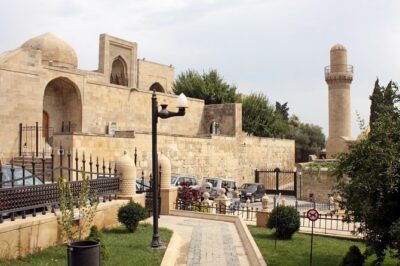
Other Azerbaijan lists this tour is on