
REVIEW · BAKU
Colors of Parajanov: Sofi Hamid Shrine and Cemetery
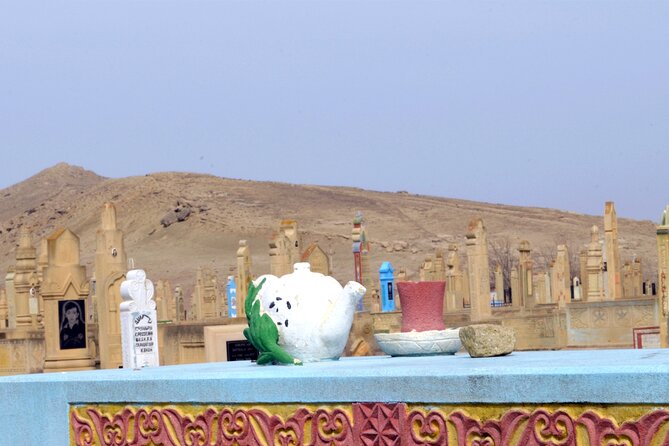
Some graveyards feel like open-air art galleries. Sofi Hamid Shrine and Cemetery, about an hour from central Baku, is one of them. Its tombs carry unusual painted images of guns, snakes, samovars, tea glasses, fruit, cows, and deer. The result is part cemetery, part shrine, and part record of how ordinary people expressed belief.
I like the strange, personal artwork and the chance to see a side of Azerbaijan that most visitors miss. I also like the quiet setting on wind-swept plains, far from Baku’s busy streets. The main drawback is the long ride for a short visit, especially if colorful tombs, Sufism, or Soviet-era art are not high on your list.
I would choose this outing for its mood rather than for a long list of sights. Guide Arif received special praise for his excellent English and enthusiasm, and a small group of no more than 10 people should make it easier to ask questions. If you have extra time, the same outing can be paired with the Candy Cane Mountains, according to the experience details shared by a past participant, but that stop is not part of the stated itinerary.
In This Review
- Key points to know before you go
- Why Sofi Hamid feels so different from Baku’s main sights
- The one-hour ride away from central Baku
- Arriving at the Sofi Hamid Shrine
- Reading the colorful gravestones
- Sergei Parajanov’s unusual film connection
- What the $69 price gives you
- Who will enjoy this outing most
- Guide quality and the small-group advantage
- Practical planning for the visit
- Should you book Sofi Hamid?
- FAQ
- How long does the Sofi Hamid Shrine and Cemetery experience last?
- How long does it take to reach the shrine and cemetery?
- How much time do you spend exploring the site?
- What is the price of the experience?
- Is admission to the shrine and cemetery included?
- How many people can join the tour?
- Can I cancel for a full refund?
Key points to know before you go
- About one hour from Baku: Travel time is included in the roughly three-hour experience, leaving about an hour at the shrine and cemetery.
- Painted tombs with unusual symbols: Look for images linked to local beliefs, daily life, animals, food, and personal hopes.
- A living cultural site: The shrine offers a way to learn about local customs, shared beliefs, and changing political eras.
- A Sergei Parajanov connection: The director used the area for colorful scenes in Ashik Kerib, his last film.
- Small-group format: The group limit is 10 people, with pickup offered and the tour returning to its meeting point.
- Best for curious art and history lovers: The experience suits anyone drawn to mysticism, Sufism, folklore, and unusual memorial art.
Why Sofi Hamid feels so different from Baku’s main sights
Baku gives you grand architecture, waterfront promenades, and polished historic streets. Sofi Hamid gives you something less controlled. The cemetery’s artwork appears tied to the people buried there and to the beliefs of the families who marked their graves.
That difference matters. In a formal museum, objects are selected and labeled. Here, the symbols are part of a working place of memory. A gun, a cow, a fruit, or a tea glass may carry a meaning that is not obvious at first glance. Your guide helps place these images within local customs instead of leaving you to guess at every stone.
The shrine and cemetery also offer a look at how life changes across decades and centuries. The experience description presents Sofi Hamid as a place where Azerbaijan’s shared beliefs and social history can be read through local artwork. You are not simply looking at old graves. You are seeing how people represented faith, work, family life, and hopes for the future.
That is the reason I find the site more valuable than its modest profile might suggest. Few people in Baku know about it, so the visit can feel personal and unexpected. It is not designed as a grand monument. Its power comes from the odd details.
Other trips worth a look in Baku:
- Baku: Gobustan, Mud Volcano, Fire Mount, Temple Lunch Entry
★ 4.9 · 3,246 reviews - Baku: Guba, Shahdag, Laza & Lunch w/ Free City & Night Tour
★ 4.8 · 1,455 reviews - BEST Gobustan, Volcanoes & Absheron Fire Tour (Group or Private)
★ 5.0 · 1,254 reviews
The one-hour ride away from central Baku
The tour begins at Nursace9RCV+QJ8 on Üzeyir Hacıbəyov in Baku, and pickup is offered. The full experience lasts about three hours, with travel time already included. The trip to Sofi Hamid takes roughly one hour, so you should think of this as a half-day outing rather than a quick city-side visit.
That travel time is both a strength and a weakness. The long ride takes you away from Baku’s center and gives the visit a sense of separation. Sofi Hamid would not feel nearly as unusual if it were tucked beside a busy shopping street.
At the same time, you should check your day before booking. A one-hour journey in each direction leaves limited time on site. If your Baku schedule is tight, you may prefer to focus on the city’s central sights. If you have an open morning or afternoon and want something far from the usual route, the distance becomes part of the appeal.
The group limit is 10 people. That is small enough for a more direct conversation with the guide, though the exact group size on your date can vary. Confirmation is sent when you book, and the activity ends back at the meeting point.
Arriving at the Sofi Hamid Shrine
After the ride, your guide gives you an introduction to the shrine and its local customs. This opening talk matters because Sofi Hamid is not just a collection of unusual gravestones. It is also a place connected with shared beliefs and religious practice.
The shrine creates the context for the cemetery. You learn what the site means locally before spending time with the tombs. That order is useful. Without it, the colors and images might seem merely odd or decorative.
The experience is especially suited to people interested in mysticism and Sufism. The shrine offers a way to consider how spiritual ideas can exist alongside everyday images. The artwork is not presented as a single, tidy style. Instead, it reflects the varied ways people express belief.
You should expect an interpretive visit, not a formal religious tour with a long schedule of rituals. The supplied information says the guide explains local customs practiced within the shrine, but it does not promise a particular ceremony or religious performance. That distinction helps set realistic expectations.
Reading the colorful gravestones
The cemetery is the heart of the outing. You have about an hour to explore the enigmatic gravestones with your guide. That is enough time to look closely, ask questions, and notice repeated themes without turning the visit into a rushed photo stop.
The colors are among the first things you notice. Many cemeteries use stone, gray lettering, and restrained decoration. Sofi Hamid uses saturated color and direct images. Tea glasses, samovars, fruit, animals, snakes, and guns create a visual language that feels both familiar and mysterious.
I would approach each tomb slowly. First, look at the image. Then consider what it might say about the person or family. A cow may point toward work or livelihood. Fruit could suggest abundance. A samovar or tea glass may connect to hospitality and daily life. These are useful prompts, not fixed answers, because the exact meaning of every symbol is not provided.
This is where a guide adds real value. You can take photographs, but a picture alone will not explain why these images matter. The site becomes more rewarding when you connect the artwork with local customs, religious belief, and the political changes that shaped Azerbaijan.
The experience description also points to the cemetery as a record of changing regimes and changing lives. That gives your visit a wider frame. You can look at the tombs not only as personal memorials but also as signs of how public culture and private belief have shifted over time.
A completely different kind of day out:
- Gobustan and Absheron tour (All inclusive)
★ 5.0 · 1,014 reviews - Shamakhi And Gabala Tour (All inclusive)
★ 5.0 · 815 reviews - From Baku: Gabala and Shamakhi Tour (Free Baku City Tour)
★ 4.8 · 695 reviews - Baku: Candy Cane, Guba, Khinaliq village with Homemade Lunch
★ 4.9 · 519 reviews
Sergei Parajanov’s unusual film connection
Sofi Hamid has a strong link to Sergei Parajanov, the Armenian-Soviet film director known for highly visual storytelling. He chose this place for Ashik Kerib, his last film, using colorful images of camels, fruit, flowers, and other scenes.
That connection adds another layer to the visit. Parajanov was drawn to places where objects, colors, and rituals could tell a story without ordinary explanation. Sofi Hamid’s painted graves and symbolic imagery fit that approach.
You do not need to be a film expert to appreciate the connection. If you know the film, the cemetery offers a direct way to think about its visual world. If you do not, the guide can still help you see why this setting appealed to a director seeking unusual colors and memorable images.
For people interested in Soviet-era art, the site is particularly useful. It shows how local visual traditions could exist outside official monuments and formal institutions. The cemetery’s imagery gives you a more personal view of culture during a period when governments and public life changed sharply.
Do not expect a film museum or a detailed Parajanov exhibition. The attraction is the place itself, and the film connection is one part of its meaning. You are visiting a real shrine and cemetery that also happened to catch a major filmmaker’s eye.
What the $69 price gives you
At $69 per person, this is not the cheapest way to spend three hours in Baku. The ticket does not appear to include a separate admission charge for the shrine or cemetery, since entry is listed as free. You are mainly paying for transport, guiding, and the chance to reach a remote place without arranging the trip yourself.
That can be fair value if you care about the subject. Public transport details are not provided, and the cemetery is about an hour away. A guided ride also means you do not have to work out the route or arrive without context.
The value is weaker if you only want a quick look at colorful graves. With roughly two hours of total travel and about one hour exploring the site, the outing asks you to give it time. You should book it because you want the explanation and the setting, not because it is a fast attraction.
Group discounts are offered, which may improve the price for larger parties. The small group limit also helps protect the quality of the guide’s explanations. With only 10 people at most, the tour should feel more focused than a large coach excursion.
The rating is 4.5 from two published ratings. That is encouraging, but the sample is very small. I would treat it as a positive signal, not proof that every departure will be perfect.
Who will enjoy this outing most
I would recommend Sofi Hamid to you if you enjoy:
- Unusual cemeteries and memorial art
- Local customs that are not explained in standard guidebooks
- Mysticism, Sufism, and religious symbolism
- Sergei Parajanov and Soviet-era film
- Quiet places away from the city
- Small-group tours with time for questions
The experience may be less suitable if you want famous landmarks, a packed sightseeing schedule, or extensive indoor exhibits. There is one main site, and the visit depends on your interest in symbols and interpretation.
It also suits repeat visitors to Baku better than first-time visitors with only a day or two. If you have not yet seen the city’s major sights, I would handle those first. Once you have room in your schedule, Sofi Hamid offers a very different view of Azerbaijan.
The outing can also work for photographers and artists. The colors, painted objects, animals, and open setting offer plenty to study. Still, you should remember that this is a cemetery and shrine, not a staged art space. Respectful behavior matters more than getting the perfect photograph.
Guide quality and the small-group advantage
Guide quality is important here because the site does not explain itself in a simple way. Arif was singled out for his excellent English, youth, and enthusiasm for the work. That is useful information if he is assigned to your departure, though guide assignments can vary.
A strong guide can turn a collection of strange images into a conversation about belief, family, work, and political change. A weaker explanation would leave you with colorful pictures but little sense of why the cemetery matters.
The maximum group size of 10 works in the tour’s favor. You can ask about a symbol without holding up a busload of people. You also have more chance to stay near the guide during the hour of exploration.
The available information does not promise that Arif will lead every tour, so I would not book solely on his name. Instead, see his excellent English and clear enthusiasm as a good sign of the kind of guiding this place needs.
Practical planning for the visit
Wear something suitable for a shrine and cemetery. The supplied information does not give a formal dress code, but modest, respectful clothing is a sensible choice for a religious site. Follow your guide’s instructions about where to walk and what you may photograph.
Keep the schedule in mind. The full activity is about three hours, but the site visit itself is about one hour after the ride. You will want enough time before and after the outing because the return is to the meeting point in Baku.
Pickup is offered, while the listed starting point is on Üzeyir Hacıbəyov. Confirm the exact pickup arrangement when you book. Mobile tickets make it easier to keep your booking available on your phone.
Free cancellation is available if you cancel at least 24 hours before the start time. Cancellations made less than 24 hours in advance are not refunded, and late changes are not accepted. The cut-off uses local time in Azerbaijan.
Should you book Sofi Hamid?
Book this experience if you want a quiet, unusual encounter with Azerbaijani culture and do not mind spending much of the outing on the road. The painted tombs, shrine customs, and Parajanov connection give you material to think about long after you leave.
Skip it if your Baku visit is short or if you prefer major monuments with clear labels and a fast pace. Sofi Hamid rewards patience and curiosity. At $69, it makes the most sense when you value the guide, transport, and access to a place that is difficult to fit into an ordinary city visit.
My practical call: choose it as an offbeat half-day trip, especially if you have already seen central Baku. Bring an open mind, give the symbols time, and let the cemetery’s unusual colors do some of the talking.
FAQ
How long does the Sofi Hamid Shrine and Cemetery experience last?
The experience lasts approximately three hours, including travel time.
How long does it take to reach the shrine and cemetery?
The ride takes about one hour before you reach Sofi Hamid.
How much time do you spend exploring the site?
You have about one hour to explore the shrine and surrounding cemetery with the guide.
What is the price of the experience?
The price is $69 per person. Group discounts are offered.
Is admission to the shrine and cemetery included?
Admission to the Sofi Hamid Shrine and Cemetery is listed as free.
How many people can join the tour?
The activity has a maximum group size of 10 people.
Can I cancel for a full refund?
Yes. You can cancel for a full refund if you cancel at least 24 hours before the experience begins. Cancellations made less than 24 hours before the start time are not refunded.
Just added in Baku
- Wine Tour Baku★ 5.0 · 4 reviews
- Wine Tour Qabala with Local Lunch★ 5.0 · 10 reviews
- Traditional Azerbaijani Cuisine Workshop★ 5.0 · 5 reviews
- Wine Crawl Baku★ 5.0 · 2 reviews
- Baku City Guided Wine Tour (snacks included)★ 5.0 · 15 reviews
- Full Day KHINALUG and the Candy Mountains Tour★ 5.0 · 15 reviews
- Tour to the North part of Azerbaijan Forests and Mountatin Quba★ 5.0 · 10 reviews
- The Magnificent Baku Night Tour★ 5.0 · 3 reviews