
REVIEW · BAKU
Azerbaijan: the land of burning flames
Fire still rises from the earth near Baku. This half-day trip across the Absheron Peninsula gives you two very different ways to understand Azerbaijan’s nickname, the Land of Burning Flames. I like the private format, which keeps the pace focused on your group, and I like the chance to visit both a historic Zoroastrian temple and a natural gas fire in one outing. The main drawback is that the $185 price does not include entrance tickets, food, or drinks.
You get hotel or apartment pickup, a professional driver, and a guide for a tour lasting about three to four hours. The schedule is compact, but the two main stops each receive about 50 minutes. If you want a short trip beyond central Baku that combines religion, trade, geology, and local history, this is a sensible choice.
In This Review
- Key points to know before booking
- Why the Absheron Peninsula matters
- Leaving Baku with a private guide
- Ateshgah Fire Temple and its five-sided courtyard
- Yanardag, where gas burns through the hillside
- What the guide adds to the experience
- Is $185 good value?
- Who will enjoy this half-day outing?
- Timing, comfort, and useful planning tips
- My booking verdict
- FAQ
- Where does the tour take place?
- How long does the tour last?
- Is hotel pickup included?
- Is this a private tour?
- What is included in the price?
- Are entrance tickets included?
- Are food and drinks included?
- What is Ateshgah Fire Temple?
- What is Yanardag?
- Can I cancel for a full refund?
Key points to know before booking
- Ateshgah Fire Temple connects Azerbaijan with Zoroastrianism and Indian traders, not only with local fire worship.
- Yanardag burns because natural gas escapes through porous sandstone, creating flames that can rise about three metres.
- The private tour keeps your group together, with hotel or apartment pickup and drop-off included.
- The $185 cost covers transport and a professional guide, but entrance fees are extra.
- Three to four hours is enough for a focused visit, though it leaves little room for a long stop or an unplanned detour.
- Guide Nigar received especially warm praise, including for staying attentive throughout the visit.
Why the Absheron Peninsula matters
Baku is more than a capital of grand buildings and Caspian Sea views. The Absheron Peninsula has long been shaped by oil, gas, trade, and fire. Natural flames once burned in several places here, and those fires helped create religious traditions and legends that still define the region.
This outing takes you outside the city to Surakhani and Yanardag. The two sites work well together. At Ateshgah, you see how people built a religious place around sacred fire. At Yanardag, you see the natural force itself, with gas rising from below the ground and catching fire at the surface.
I appreciate that the tour is not just a photo stop at a flame. The guide is there to explain how Azerbaijan’s geology affected its faith, trade routes, and identity. That context gives the visit more purpose than simply watching fire burn.
The arrangement is also practical. Pickup from a Baku hotel or apartment saves you from figuring out transport to sites outside the center. Since only your group participates, you can ask questions as you go instead of following a large crowd on a fixed script.
Other trips worth a look in Baku:
- Baku: Gobustan, Mud Volcano, Fire Mount, Temple Lunch Entry
★ 4.9 · 3,246 reviews - Baku: Guba, Shahdag, Laza & Lunch w/ Free City & Night Tour
★ 4.8 · 1,455 reviews - BEST Gobustan, Volcanoes & Absheron Fire Tour (Group or Private)
★ 5.0 · 1,254 reviews
Leaving Baku with a private guide
Your guide and driver collect you from your hotel or apartment and take you toward the two Absheron sites. The trip begins with a brief pickup segment, then moves directly to the temple and burning mountain.
The private setup is the strongest practical feature. It gives you a more personal experience and avoids the stop-and-start rhythm that can come with a large group. If your group has a particular interest in Zoroastrianism, Azerbaijan’s gas fields, or the country’s links with India, you can direct the conversation toward those subjects.
The tour is listed at about three to four hours. That makes it easy to fit around a morning or afternoon in Baku. It also means you should keep your expectations realistic. This is a focused excursion, not a full day across the peninsula. The planned time at each main site is about 50 minutes, enough for an introduction and a proper look, but not a leisurely exploration.
The guide and driver are included. Fuel is included as well. Those details matter because the tour is priced as a private outing rather than as a simple ticketed visit. You are paying for the vehicle, coordination, and one-on-one explanation as much as for the sites themselves.
Ateshgah Fire Temple and its five-sided courtyard
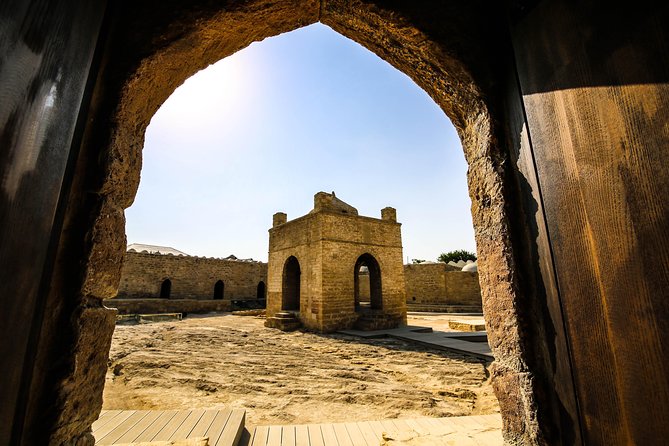
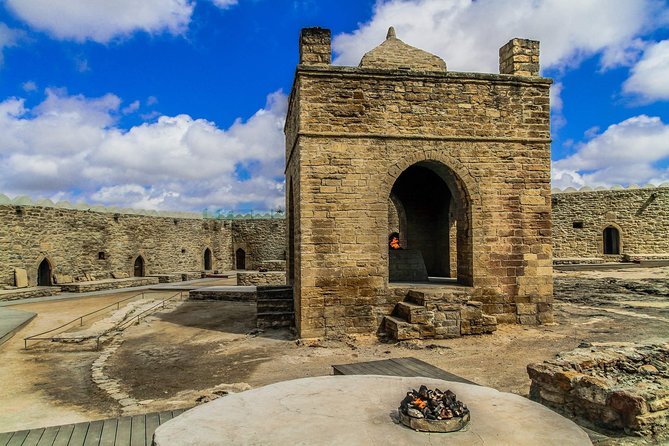
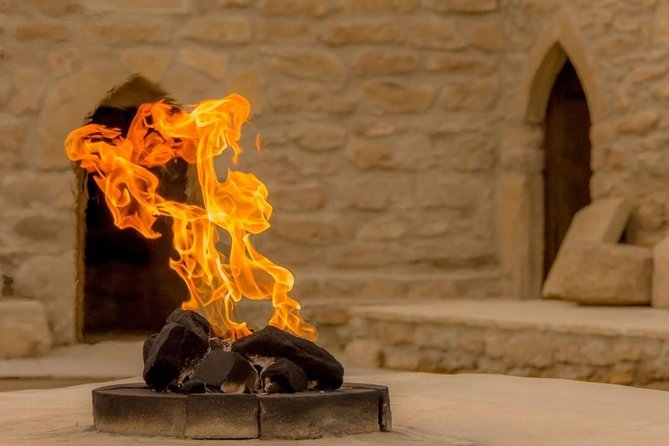
The first major stop is Ateshgah, often called the Fire Temple of Baku. It sits in Surakhani, a suburb of Baku, and has a castle-like shape. Its pentagonal complex surrounds a central courtyard, with small cells around the edges and a four-pillared altar in the middle.
Give yourself time to notice the layout. The courtyard is not just a backdrop for photographs. It helps you picture how the site functioned as a religious and philosophical center. The cells around it were connected with monks and pilgrims, while the central altar focused attention on the fire.
Ateshgah was built during the 17th and 18th centuries. It later became a pilgrimage center for Zoroastrians from the northwestern Indian subcontinent. These visitors were involved in trade with the Caspian region and used the famous Grand Trunk Road, so the site also tells a story about movement, commerce, and connections across Asia.
That is one of the temple’s most interesting features. It is easy to think of Azerbaijan’s fire traditions as isolated and purely local. Ateshgah shows a broader picture. The temple’s story includes religious travelers and merchants from India, as well as the wider trade network that linked the Caspian area with distant places.
The complex was abandoned in the late 19th century, probably as the Indian population in the area declined. That change gives the site a human scale. Religious places do not always disappear because their buildings fail. Sometimes the communities that support them move on.
You have about 50 minutes here. That should allow you to walk through the complex, study the altar and surrounding rooms, and listen to the guide’s explanation. I would pay close attention to the cultural links, since they are what make Ateshgah more than an old stone building.
The temple was nominated for UNESCO World Heritage status in 1998. Nomination is not the same as inclusion on the final list, so it is best to treat this as an important heritage site with a formal international nomination, not to assume it is a UNESCO World Heritage Site.
One point to remember: the entrance ticket is not included in the tour price. Budget for that separately. The supplied details do not state the current admission cost, so check before booking if you are working with a tight budget.
Yanardag, where gas burns through the hillside
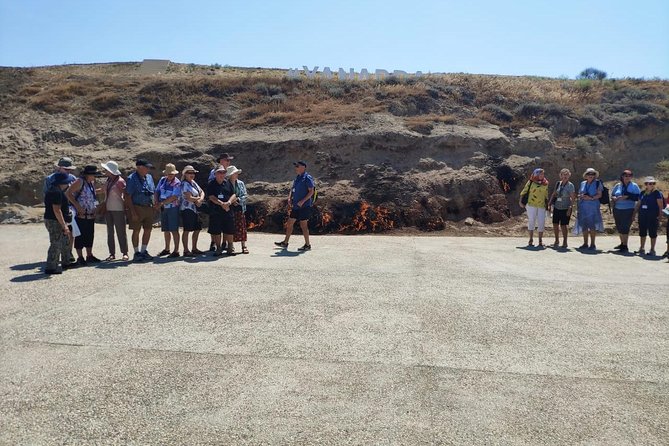
The second main stop is Yanardag, also called the Burning Mountain. It is a natural gas fire on a hillside of the Absheron Peninsula near the Caspian Sea. Gas escapes from below the ground through a thin layer of porous sandstone and burns continuously.
The flames can rise about three metres, or roughly 9.8 feet. That is large enough to feel unusual, but this is not a wall of fire covering an entire mountain. Think of it as a long-burning line of flames along a hillside, created by gas reaching the open air.
The reason for the fire is geological. Hydrocarbon gases beneath the Absheron Peninsula rise through cracks and porous rock. Once the gas meets oxygen and an ignition source, it burns at the surface. The result is a natural phenomenon that has been seen and described for centuries.
Alexandre Dumas wrote about seeing a similar fire during one of his visits to the region. The same type of natural flame helped shape the religious importance of fire temples in Azerbaijan. Visiting Yanardag after Ateshgah makes that connection clear: first you see the human response to fire, then you see the underground gas that helped inspire it.
A visit here lasts about 50 minutes. That is enough time to view the flames, hear the explanation, and understand why the site matters. You might find the stop visually simpler than the temple. Ateshgah has courtyards, walls, and rooms to explore, while Yanardag centers on one natural feature.
Still, the contrast is the point. The mountain gives you a physical explanation for a major part of Azerbaijan’s cultural identity. Few places allow you to connect a living natural fire so directly with old religious practices and modern energy history.
The admission ticket is also separate here. Food and drinks are not included in the tour either, so plan to eat before or after the excursion rather than expecting a meal during the visit.
A completely different kind of day out:
- Gobustan and Absheron tour (All inclusive)
★ 5.0 · 1,014 reviews - Shamakhi And Gabala Tour (All inclusive)
★ 5.0 · 815 reviews - From Baku: Gabala and Shamakhi Tour (Free Baku City Tour)
★ 4.8 · 695 reviews - Baku: Candy Cane, Guba, Khinaliq village with Homemade Lunch
★ 4.9 · 519 reviews
What the guide adds to the experience
A private guide can make the difference between seeing two unusual places and understanding them. At Ateshgah, you need context about Zoroastrian pilgrimage, the Indian trading community, and the temple’s later abandonment. At Yanardag, you need a clear explanation of natural gas and why the flames continue to burn.
One guide named Nigar received especially strong praise for being brilliant throughout the experience and for taking care of the group at every stage. That kind of attentiveness matters on a short tour. With only 50 minutes at each site, a guide who explains the key points clearly can help you use the time well.
The private format also lets you ask for clarification. If a term such as Zoroastrianism is new to you, or if you want to know more about the Grand Trunk Road, you can stop and ask. In a large group, the guide may need to keep moving.
The tour provider is Cactus Travel Azerbaijan. The supplied information also describes the guide as accredited and the driver as professional. The company arranged a wider Azerbaijan and Georgia trip for one past customer, who described the organization as very good and the tiredness after the touring as pleasant. That is useful evidence of solid coordination, though the sample of available feedback is small.
Is $185 good value?
At $185 per person, this is not the cheapest way to see Ateshgah and Yanardag. The price is easier to justify if you value private transport, hotel pickup, a dedicated guide, and a schedule arranged for your group.
The cost includes:
- Hotel or apartment pickup and drop-off
- Professional guide
- Professional driver
- Fuel surcharge
- Private participation for your group
The price does not include:
- Entrance tickets
- Food and nonalcoholic drinks
- Alcoholic drinks, which are available to purchase
The missing entrance fees are the main budget detail to watch. You should ask for the current ticket prices before booking so the final cost does not surprise you.
For a solo visitor, $185 may feel high. For a couple or small private group, the value improves because you receive door-to-door service and do not need to arrange a taxi or negotiate separate transport. The exact value depends on the number of people in your booking and how much you care about having a private guide.
I would compare this price with the cost and effort of arranging both sites independently. The tour removes the transport problem and gives you explanations at each stop. If you are comfortable organizing your own car and learning the background on your own, you may prefer a cheaper independent visit. If you want a smooth half-day with little planning, the package is more appealing.
Who will enjoy this half-day outing?
I would recommend it to anyone staying in Baku who wants to understand the fire theme that appears throughout Azerbaijan’s culture. It suits first-time visitors who want a clear introduction to the Absheron Peninsula without giving up an entire day.
It is also a good match for:
- Couples and families who prefer a private vehicle
- Small groups who want to stay together
- Visitors interested in Zoroastrianism and religious history
- People curious about geology, natural gas, and Azerbaijan’s energy story
- Anyone who values hotel pickup and a fixed three to four-hour schedule
You may want to choose another plan if you prefer long visits at each site, a broad peninsula tour, or included meals and admission. The schedule is efficient rather than slow. It gives you the two headline sights and their main context, then returns you to Baku.
The experience is likely to suit most people physically, since the provider states that most participants can take part. Still, the available information does not give detailed guidance about surfaces, seating, or specific accessibility arrangements. If you have mobility needs, contact the provider before booking.
Timing, comfort, and useful planning tips
Keep the half-day timing in mind when planning your Baku schedule. The stated duration is approximate, so do not place a time-critical reservation immediately after the tour. Pickup, traffic, and the time spent asking questions can affect the return time.
Wear practical clothing for outdoor sightseeing. Yanardag is an open-air stop, and conditions may feel different from those inside the temple complex. The supplied details do not promise shade, refreshments, or a specific weather plan, so bring anything you normally need for a short outdoor visit.
Have your camera ready, but listen first. The flames at Yanardag are the obvious photograph, yet the temple’s courtyard and central altar may tell you more about the human side of the story. I would also note the contrast between a carefully built religious complex and a natural fire emerging from bare rock.
You should contact Cactus Travel Azerbaijan before booking, as requested in the tour details. Confirmation is provided at booking, and pickup is available from a hotel or apartment in Baku. Free cancellation is available if you cancel at least 24 hours before the start time. Within 24 hours, the payment is not refunded, and changes made inside that window are not accepted.
My booking verdict
I would book this tour if I wanted a short, private introduction to the Absheron Peninsula and did not want to arrange transport myself. The combination of Ateshgah’s religious and trading connections with Yanardag’s natural gas fire gives the outing a clear story, not just two unrelated stops.
The decision comes down to price and pace. At $185 per person, with entrance tickets extra, it is best for people who value convenience and personal attention. It is less attractive if you are traveling alone on a strict budget or want a long, flexible day.
Ask about the current admission fees before committing, then reserve with enough time to keep the cancellation option open. If Nigar is available, her praised attentiveness would be another reason to request her, though guide assignments cannot be guaranteed from the information provided.
FAQ
Where does the tour take place?
The tour begins with pickup in Baku and visits the Ateshgah Fire Temple in Surakhani and Yanardag, also called the Burning Mountain, on the Absheron Peninsula.
How long does the tour last?
The experience lasts approximately three to four hours.
Is hotel pickup included?
Yes. Pickup and drop-off are included from your Baku hotel or apartment.
Is this a private tour?
Yes. Only your group participates in the activity.
What is included in the price?
The price includes fuel surcharge, a professional guide, a professional driver, and hotel pickup and drop-off.
Are entrance tickets included?
No. Admission tickets for the Ateshgah Fire Temple and Yanardag are not included.
Are food and drinks included?
No. Food and drinks are not included. Alcoholic drinks are available to purchase.
What is Ateshgah Fire Temple?
Ateshgah is a pentagonal, castle-like religious complex in Surakhani. It was built during the 17th and 18th centuries and served as a pilgrimage and philosophical center for Zoroastrians from the northwestern Indian subcontinent.
What is Yanardag?
Yanardag is a natural gas fire on a hillside near Baku. Gas escaping through porous sandstone creates flames that can rise about three metres.
Can I cancel for a full refund?
Yes, if you cancel at least 24 hours before the experience start time. Cancellations made less than 24 hours before the start time are not refunded.
Just added in Baku
- Wine Tour Baku★ 5.0 · 4 reviews
- Wine Tour Qabala with Local Lunch★ 5.0 · 10 reviews
- Traditional Azerbaijani Cuisine Workshop★ 5.0 · 5 reviews
- Wine Crawl Baku★ 5.0 · 2 reviews
- Baku City Guided Wine Tour (snacks included)★ 5.0 · 15 reviews
- Full Day KHINALUG and the Candy Mountains Tour★ 5.0 · 15 reviews
- Tour to the North part of Azerbaijan Forests and Mountatin Quba★ 5.0 · 10 reviews
- The Magnificent Baku Night Tour★ 5.0 · 3 reviews